
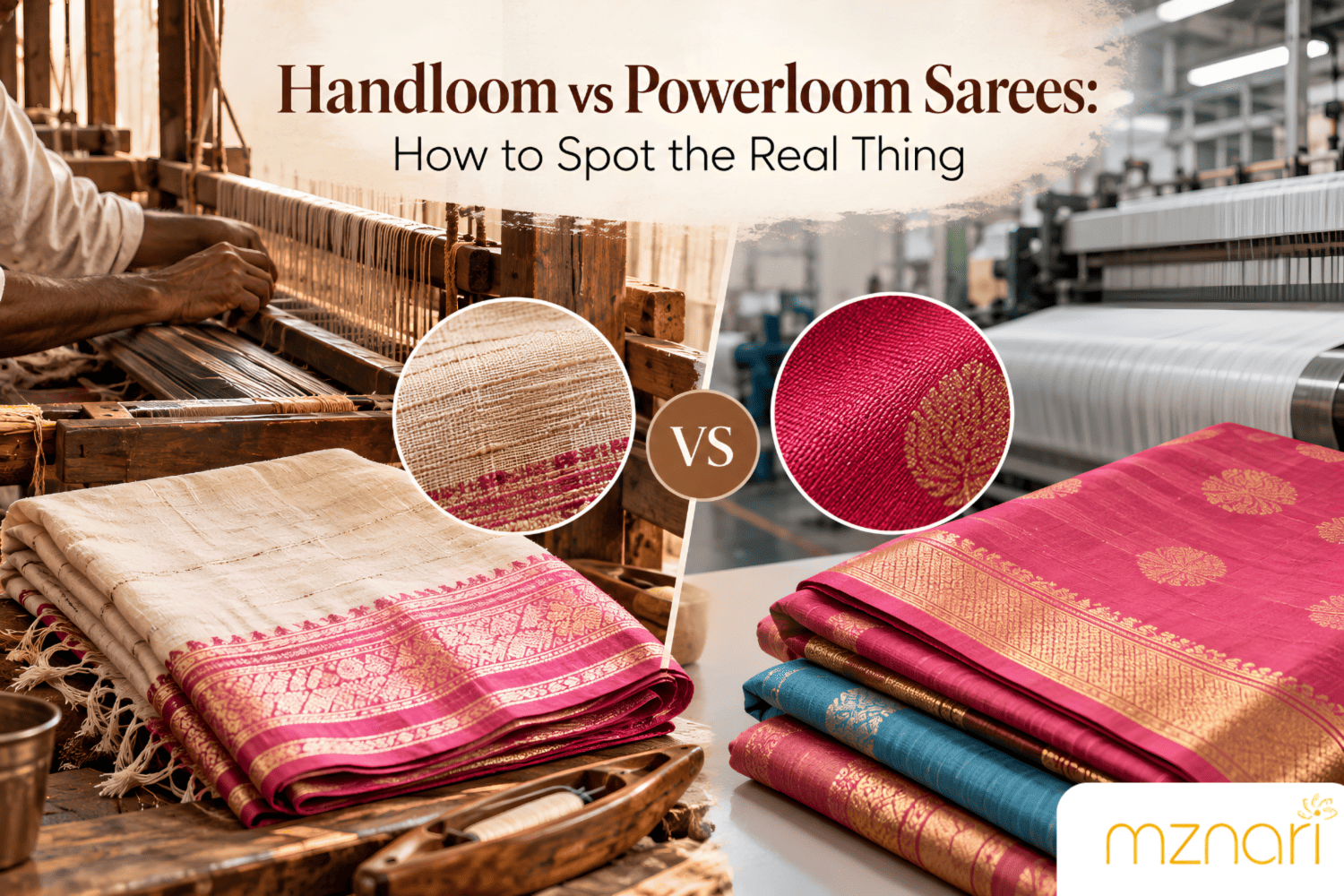
Confused between handloom and powerloom sarees? Learn the exact differences, how to check authenticity, and why handloom is worth the price. Shop real handloom sarees at Manari
Handloom vs Powerloom Sarees: How to Spot the Real Thing
"Handloom" is one of the most used — and most misused — words in saree shopping. Many sarees sold as "handloom" online are actually powerloom-made. Since the price difference can be significant, it's worth knowing exactly what separates the two.
What Is a Handloom Saree?
A handloom saree is woven entirely by hand on a manual loom, thread by thread, by a skilled weaver. This process is slow — a single saree can take anywhere from a day to several weeks depending on the complexity of the design. Because human hands control every shuttle pass, handloom fabric naturally has tiny irregularities that add character and durability.
What Is a Powerloom Saree?
A powerloom saree is machine-woven. It's faster to produce, more uniform in appearance, and generally more affordable. Powerloom isn't "fake" — it's simply a different, industrial production method that lacks the hand-crafted variation and heritage value of handloom weaving.
Key Differences at a Glance
| Feature | Handloom | Powerloom |
|---|---|---|
| Production | Hand-woven, slow | Machine-woven, fast |
| Texture | Slight natural irregularities | Perfectly uniform |
| Reverse side | Slightly rough, visible thread work | Smooth, identical to front |
| Price | Higher (labour-intensive) | Lower |
| Durability | Very high, improves with age | Moderate |
| Uniqueness | No two pieces identical | Mass-produced, identical |
How to Identify a Genuine Handloom Saree
- Check the reverse side. Handloom sarees usually show slightly looser or uneven thread work on the back — powerloom fabric looks identical on both sides.
- Look for the Handloom Mark. Genuine handloom products often carry the government-issued India Handloom Brand tag or Handloom Mark certification.
- Feel the texture. Handloom fabric has a subtly uneven, organic feel. Powerloom fabric feels stiffer and more mechanically perfect.
- Check the border join. In handloom sarees, the border is often woven directly into the fabric (interlocked weave), not stitched or printed on separately.
- Ask about the weaving cluster. Genuine handloom sellers can usually tell you which region or weaving cluster the saree comes from (e.g., Maheshwar, Chanderi, Pochampally).
Why Handloom Costs More — And Why It's Worth It
Handloom weaving directly supports India's 31+ lakh handloom worker households, according to the Fourth All India Handloom Census. Every handloom purchase fincreasingly at risk of disappearing. Beyond the ethical angle, handloom fabric is simply built to last — it softens and improves with age rather than wearing thin.
FAQs
Is handloom saree better than powerloom?For durability, uniqueness, and supporting traditional craft, yes. Powerloom sarees can still be a good budget-friendly option, but they don't offer the same texture, longevity, or artisan story.
Why are handloom sarees more expensive?Because they take significantly longer to weave by hand and require more skilled labour, handloom sarees cost more to produce than machine-made powerloom sarees.
Can I tell handloom from powerloom just by looking at a photo?It's difficult but not impossible — look for slight irregularities in the weave and check if the seller mentions the specific weaving cluster or provides a Handloom Mark certification.
Do handloom sarees need special care? Mostly the same care as any cotton or silk saree — hand wash or dry clean depending on fabric, dry in shade, and store folded in a breathable cover.