
Discover the story behind Bagru print sarees — Rajasthan's centuries-old hand block-printing craft. Learn how to identify, style, and care for one. Shop at Mznari
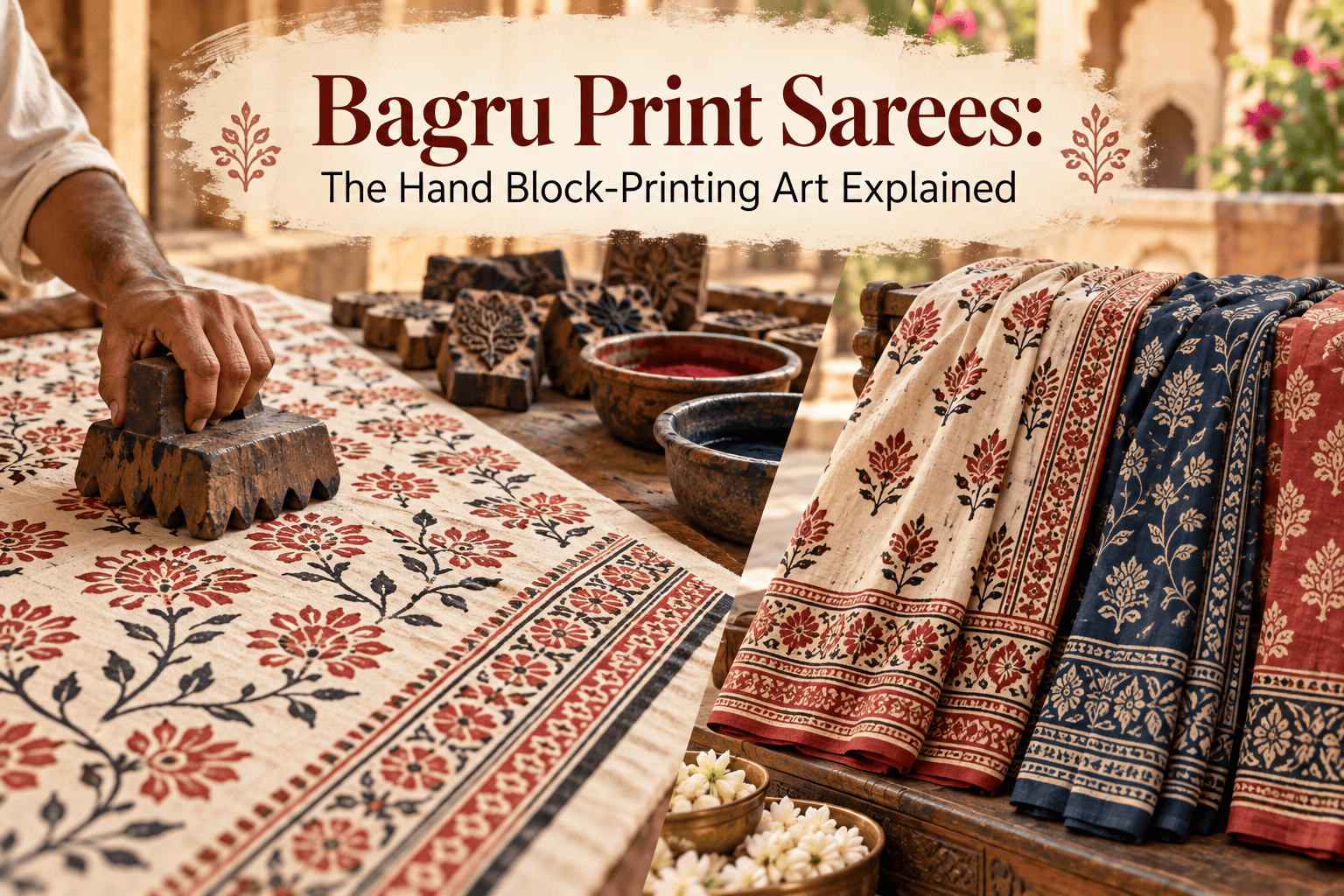
Bagru Print Sarees: The Hand Block-Printing Art Explained
Walk into any conversation about Indian block prints and one name comes up again and again: Bagru. Named after a small town near Jaipur, Rajasthan, Bagru print has quietly become one of the most sought-after saree styles for women who want handcrafted, understated elegance.
What Is Bagru Print?
Bagru print is a hand block-printing technique from Bagru village, Rajasthan, traditionally practised by the Chhipa community of printers for centuries. Wooden blocks, hand-carved with intricate motifs, are dipped in natural dye and stamped onto fabric one impression at a time.
What makes Bagru instantly recognisable is its colour palette — earthy indigo, mustard yellow, madder red, and a signature dabu (mud-resist) technique that creates crisp white or negative-space patterns against a dark background.
What Makes It Different From Other Block Prints
| Feature | Bagru Print | Machine/Digital Print |
|---|---|---|
| Process | Hand-stamped, block by block | Printed in seconds by machine |
| Dyes | Often natural, vegetable-based | Usually synthetic |
| Pattern | Slight variation between motifs | Perfectly identical repetition |
| Texture | Dye sits into the fabric weave | Sits on top, can feel stiff |
| Uniqueness | No two pieces are exactly alike | Mass-produced |
Popular Bagru Motifs
- Booti — small, repeating floral motifs
- Jaal — an interconnected net-like pattern covering the full fabric
- Paisley (Kairi) — mango-shaped motif, a classic across Indian textiles
- Dabu prints — mud-resist technique producing bold outlined patterns
How to Identify a Genuine Bagru Print Saree
- Look closely for slight inconsistencies between motifs — a sign of hand-stamping, not machine printing
- Check if the dye has penetrated the fabric rather than sitting on the surface
- Ask if natural or vegetable dyes were used — genuine Bagru work often uses indigo, turmeric, and madder root
- Genuine Bagru sarees are usually printed on cotton or mul cotton base fabric
How to Style a Bagru Print Saree
- Keep the blouse solid-coloured, picking one shade from the print, to let the block work stand out
- Pair with silver oxidised jewellery for an earthy, festival-ready look
- Ideal for daytime events, casual outings, and office wear — the print does the styling work for you
Caring for a Bagru Print Saree
- Hand wash separately in cold water, especially for the first few washes, since natural dyes can bleed slightly
- Avoid harsh detergents — a mild soap protects the dye and fabric
- Dry in shade to prevent colour fading from direct sunlight
- Iron on the reverse side to protect the printed surface
FAQs
Is Bagru print the same as Sanganeri print?No. Both are hand block-printing styles from Rajasthan, but Bagru typically uses darker, earthy tones with mud-resist (dabu) work, while Sanganeri favours lighter backgrounds with fine floral motifs.
Does colour fade from Bagru print sarees?Slight fading is natural with any hand-dyed fabric, especially in the first few washes. Cold water hand washing and shade-drying help preserve the colour longer.
Are Bagru print sarees suitable for daily wear?Yes, especially the cotton and mul cotton versions, which are lightweight, breathable, and easy to maintain.
What makes Bagru prints eco-friendly?Traditional Bagru printing often uses natural, vegetable-based dyes and a chemical-free mud-resist technique, making it a more sustainable choice than synthetic prints.